
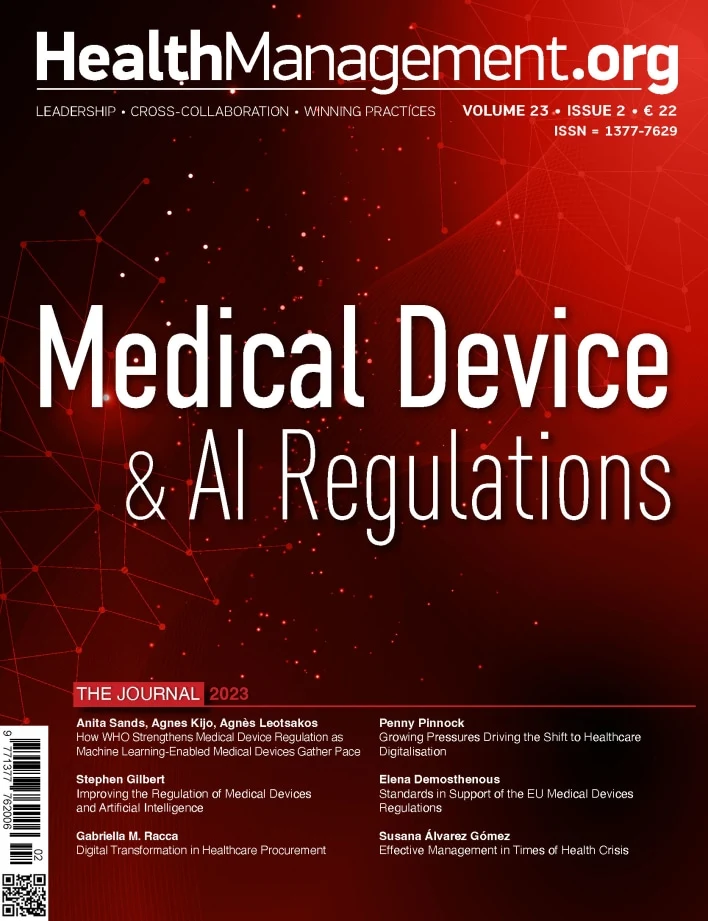
HealthManagement, Volume 23 - Issue 2, 2023
Download PDF |
 |
| PRINT OPTIMISED |
Download PDF |
 |
| SCREEN OPTIMISED |
Editorial

Medical Device & AI Regulations
The quickly evolving major presence of Artificial Intelligence in healthcare means the current regulatory landscape is changing. AI-based medical devices are rapidly revolutionising the industry across the globe, but along with the many positive developments made in healthcare delivery, calls for more regulatory oversight are growing. Many countries are rethinking and re-tooling their regulatory protocols...

Spotlight
Point-of-View - United Imaging Healthcare
Latest Advances in MRI
Thanks to a partnership with FORA S.p.A., United Imaging Healthcare’s first OMEGA uMR is now present in Europe. The uMR Omega™, the first ever 75cm, Ultra-wide-bore 3.0T MRI, has been recently installed in the world-renowned IRCSS Sacro Cuore Don Calabria hospital. Since the hospital’s establishment in 1922, this impressive 549-bed institution has been the Veneto...
Point-of-View - Mindray
Mindray Resona R9 Platinum Edition – A New Leap for Precision Ultrasound
Powered by ZONE Sonography Technology, this state-of-the-art Resona R9 takes clinical intelligence to new heights, providing a complete solution for both diagnostic and interventional ultrasound needs. Designed to streamline workflow and ensure consistent and accurate results, the Resona R9 offers advanced intelligent tools such as high frame rate CEUS, high frame rate STE, uHIT, iFusion, VFlow, and...

Cover Story

WHO Strengthens Medical Device Regulation as Machine Learning-Enabled Medical Devices Gather Pace
Effective regulatory systems are an essential component of health system strengthening and contribute to better public health outcomes, even more so in the age of medical devices that are enabled by machine learning. Without medical devices, many critical healthcare procedures would not be possible. WHO provides guidance to its Member States on how to regulate medical devices to ensure access to lates...

Improving the Regulation of Medical Devices and Artificial Intelligence
Stephen Gilbert, Professor for Medical Device Regulatory Science at the Else Kröner Fresenius Center for Digital Health at Dresden University of Technology, spoke to HealthManagement about the need for improved and balanced regulation of medical devices and artificial intelligence, and what can be expected in the future. What is your stand on the need for better regulation of AI and machine learning m...


Standards in Support of the EU Medical Devices Regulations
The use of harmonised standards in support of the Medical Devices Regulations (MDR & IVDR) is a proven and trusted way to ensure compliance, quality, safety and efficiency of products, production processes, management systems, services and test-methods. They are developed as per the EU request to the European Standardisation Organisations (CEN & CENELEC) and cited in the Official Journal of the EU....
Digital Transformation

Growing Pressures Driving the Shift to Healthcare Digitalisation
Digital and AI-driven technologies tangibly improve the effectiveness of healthcare delivery and access – whether holistic patient management, clinical productivity, or hospital site utilisation all of which ultimately improves patient outcomes. Yet the sector faces financial challenges to acquire the clinical, care, collaboration and buildings technology required to make the digital transition complete....

Point-of-View - Straumann Group
Digitisation for DSOs
Discover why dental support organisations must go digital and how they can do so. Four guiding principles can help DSOs select and implement digital initiatives that result in optimised efficiencies, consistent treatment outcomes, and an improved experience for both patients and providers that fuels the stability and growth of organisations. Digitisation is essential to the continued growth and stabil...

Digital Transformation in Healthcare Procurement
The article explores the potential of AI coupled with digital innovation as it pertains to future healthcare procurement. The importance of interoperability and qualification for the Virtual Company Dossier, and the potential benefits of cross-border procurement and digital platforms are discussed in detail. The article also highlights the need for greater involvement of academia in this and better collabo...

Revolutionising Medicine: The Power of Digital Algorithms in Healthcare
Medical digital algorithms are computer programs that use complex mathematical equations to analyse data and make predictions about medical conditions. These algorithms have the potential to revolutionise healthcare by improving accuracy, reducing costs, and providing personalised treatment plans. Despite their potential benefits to transform healthcare, medical digital algorithms also raise concerns a...
Medical Imaging

Radionuclide Therapy in Paediatric Patients
Radionuclide therapy uses radioactive substances for the selective delivery of radiation to tumors or target organs, providing a valid alternative to surgery or traditional medical treatments in paediatric patients. In particular, it combines the advantage of target selectivity and therapeutic strategy with curative intent or for disease control and palliation. Radionuclide therapy is a specialise...

Point-of-View - Affidea
One Ring to Rule Them All in AI
Artificial Intelligence in radiology is growing at a rapid pace. Alessandro Roncacci, SVP and CMO of Affidea, and Stéphane Maquaire, GM for Europe at Incepto Medical, reveal the dynamic partnership in Portugal, bringing to the national level the benefits and added value of AI solutions. What is the current landscape of artificial intelligence in radiology, and what is Incepto’s vi...


Central Role of Nuclear Medicine in Personalised Medicine
Molecular radionuclide imaging and therapies have a central role in the management of some oncological diseases, in particular they find a central application in neuroendocrine tumours (NETs). Peptide receptor imaging is a fundamental part of the tumour staging, preoperative imaging, therapy selection and restaging. Using the same drug, labelled with a different radionuclide, it’s possible to offer a the...
Governance & Leadership

Point-of-View
Business Continuity Management in Medical Technology: Ensuring Uninterrupted Healthcare Services
The article emphasises the importance of Business Continuity Management (BCM) in medical technology to ensure uninterrupted healthcare services. It discusses the need for BCM, challenges in implementation, benefits, and best practices. The focus is on identifying potential disruptions, developing response plans, and maintaining effective communication. BCM in Medical Technology: The article highlights...

Effective Management in Times of Health Crisis
The COVID-19 pandemic and the rapid evolution of events on a national and international scale required the adoption of immediate and effective measures to deal with these events. The rapid responsiveness of Public Procurement Units to the pandemic. The need for public-private partnerships is illustrated. The importance of collaboration between different public administrations is key. Introduction...
AI & Robotics

How Imaging Generative AI Will Transform the Medical Radiological Practice
Generative AI imaging has emerged as a powerful tool in radiology, allowing for the creation of highly detailed bio-models that can assist in diagnosis and treatment planning. Generative AI algorithms can generate 3D models of organs, tissues, and other structures with unprecedented accuracy and speed. This technology thus has the potential to revolutionise the field of radiology, enabling more accurate a...
