HealthManagement, Volume 22 - Issue 6, 2022
Download PDF |
 |
| PRINT OPTIMISED |
Download PDF |
 |
| SCREEN OPTIMISED |
Editorial

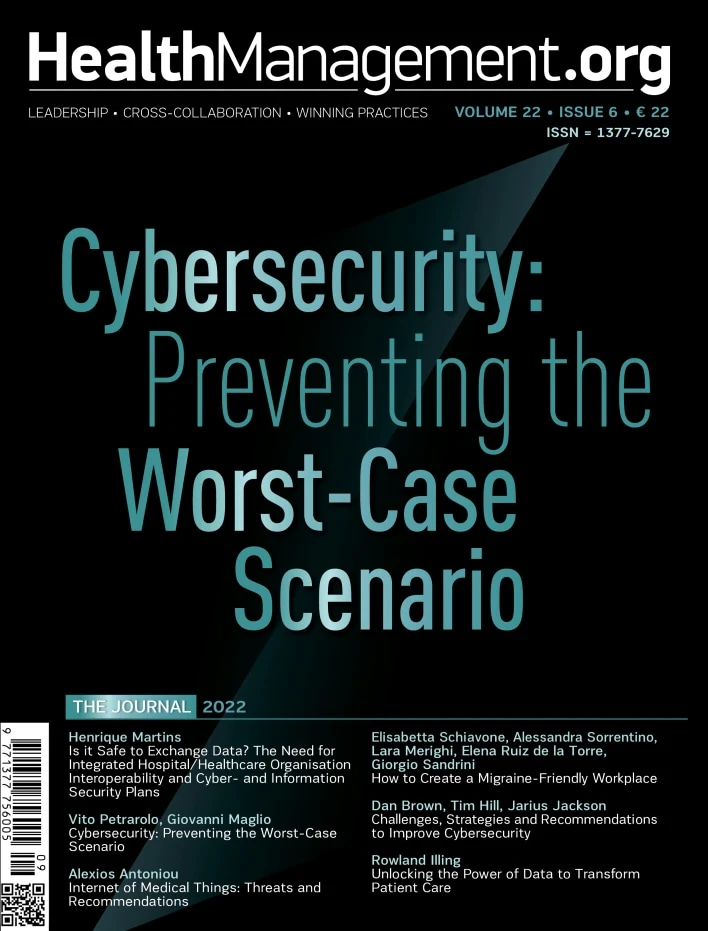
Cybersecurity – Preventing the Worst-Case Scenario
As healthcare has become ubiquitously digitised, we have reaped the benefits of more easily accessed and shared patient data. Clinicians know more about their patients’ medical history and have digital tools to better assist in diagnosis and care. But this has also increased our risks. Bad actors and recognising the monetary value of healthcare data are increasingly putting our healthcare practitioners...

Cover Story

Is it Safe to Exchange Data?
One of the biggest health organisation challenges is to protect patient data within but also, and increasingly, in inter-organisational transfer processes. This challenge brings together three interconnected topics which are very important for effective, efficient, safe, sustainable and high-quality healthcare. Patients can be at risk of harm due to breach in the safety of clinical procedures as well as w...

Point-of-View – Cybersecurity – Preventing the Worst-Case Scenario
Challenges, Strategies and Recommendations to Improve Cybersecurity
Cybersecurity is vital for the effective functioning of healthcare organisations and protecting private and important patient information and data. HealthManagement.org spoke to Dan Brown, Chief Technology Officer, Tim Hill, Global Security and Privacy Program Manager and Jarius Jackson, Data Protection Officer & Security & Privacy Tech Specialist at Agfa HealthCare, to discuss the main challenges...

Cybersecurity: Preventing the Worst-Case Scenario
Cyber threats and vulnerabilities cannot be completely eliminated as no informatic system is completely impenetrable. However, certain measures can be implemented to limit the likelihood of a breach or reduce its scale and consequences. Effective leaders must focus on building mission-critical systems with the goal of quickly recovering from both anticipated and unexpected attack scenarios. Elements of the...

Point-of-View - Successful Digitilisation Pathways
Unlocking the Power of Data to Transform Patient Care
Cloud computing revealed its tangible positive impact on health outcomes during one of the worst global health crises. But we’re still only scratching the surface of what’s possible. By eliminating data silos and enabling providers to view complete medical histories, interoperability stands to provide a better patient experience and empower individuals to take greater control over their health care.The...

Internet of Medical Things: Threats and Recommendations
Internet of Medical Things (IoMT) aims to deliver game-changing benefits to healthcare institutions, patients and society. It supports more accurate diagnoses, improved treatments, and better availability of care. IoMT systems face challenges, such as the security of all the interconnected components. This article aims to present a few vulnerable components and point out recommendations for better security....

Point-of-View - Disease Assessment and Management
Syncope Diagnosis, Treatment and Management
James Frith is a consultant physician and geriatrician in Newcastle, England. He is also a researcher at the Newcastle University. His academic interests focus on orthostatic hypotension, in particular, the non-drug treatments of orthostatic hypotension that significantly overlap with falls and syncope. HealthManagement. org spoke to Dr Frith on the importance of accurate syncope diagnosis and effective tre...

Clinical Care Management

How to Create a Migraine-Friendly Workplace
Is it possible to create a safe and inclusive workplace for people with migraine? Yes, it is. Companies need to be aware that an environment that meets the specific needs of those suffering from invisible diseases can become a facilitator and that it is necessary to apply design criteria that reduce the presence of triggers. Work is where the majority of people of working age spend most of their day.The imp...

Point-of-View - Medical Imaging
Future Trends in Radiology and Healthcare
An overview of the big trends in radiology/healthcare and what this means for the future of radiology, GE Healthcare and the industry. Data will need to be more integrated to provide longitudinal insights, enabling quicker and more impactful decision-making with Artificial Intelligence (AI).Staff shortages and burnout among radiologists have been an issue for years and are now more widespread than ever....

Point-of-View - Clinical Care Management
Point-of-Care EEG in the ICU: Towards a New Standard of Seizure Care
Nonconvulsive status epilepticus (NCSE) is often invisible or impossible to distinguish from other sources of altered mental status. Without immediate and continuous access to EEG monitoring, physicians must treat without confirmation or delay their diagnosis. Point-of-Care EEG is helping to close both these gaps and make EEG accessible across health networks. Electrographic seizures have major implicatio...

Point-of-View Clinical Care Management
Stability in the Face of Change
An interview with Joerge Aumueller providing an overview of the changes in the dental industry giving rise to dental service organisations and the challenges they face in fulfilling the promise of consolidation, creating a greater end-to-end experience for patients and strengthening operations and efficiency. Dental service organisations (DSOs) can lead the way in dentistry’s transformation as a technolo...