Lung cancer screening has spent two decades proving that low-dose CT can shift diagnosis towards earlier-stage disease. England is now providing a different kind of evidence: what happens when screening is delivered at national scale. Five-year results from the NHS England Lung Cancer Screening Programme show both the clinical impact and the operational demands created when CT moves from a targeted pilot into routine population care.
More than 2.5 million invitations and 7,193 lung cancers
Between April 2019 and March 2025, 2,510,092 people were invited for a baseline Lung Health Check. Just under half, 49.0%, completed the assessment. Of those assessed, 584,095 met the multivariable risk threshold for screening and 528,686 underwent a baseline low-dose CT.
By March 2025, the programme had diagnosed 7,193 lung cancers. Of these, 63.1% were stage 1 and 12.6% were stage 2. In other words, roughly three quarters were detected at stages 1 or 2. The national data also show that early-stage diagnosis has risen across deprivation groups, with the largest improvement seen in the most deprived quintile.
The programme is not a randomised trial, and the authors caution that the real-world dataset has limitations. Its value lies in demonstrating implementation at a scale that few health systems have yet achieved.
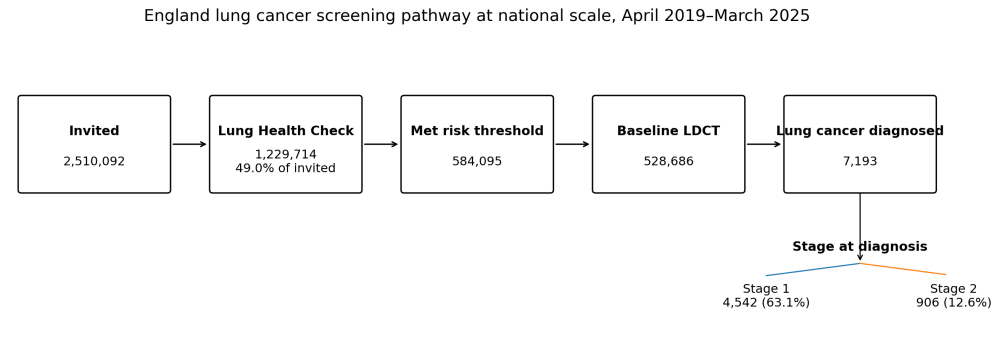
Figure 1. England lung cancer screening pathway at national scale, April 2019–March 2025. Adapted from Lee RW et al., Nature Medicine (2026). Data and source article licensed CC BY 4.0.
The operating model protects scarce CT capacity
The delivery model is deliberately designed around capacity. Risk assessment comes first, rather than sending every eligible person directly to CT. Of the 1.23 million Lung Health Checks completed, 83.2% were carried out by telephone, with face-to-face confirmation where required for those proceeding to screening.
Scanning is delivered through a mix of fixed and community-based mobile units. Volumetry and computer-aided detection for pulmonary nodules are mandated, and scans are reported by thoracic radiologists with lung cancer expertise under a national quality-assurance framework.
Participants with no actionable findings move to biennial screening rather than annual CT. The authors acknowledge that biennial strategies are not the most favourable on the cost-effectiveness frontier, but they are more affordable and more deliverable given capacity constraints. That trade-off is central to national-scale screening.
Screening creates work beyond the scanner
The CT examination is only the start of the pathway. Positive findings require multidisciplinary review and access to diagnostic and treatment services. The programme has already placed pressure on existing services and required additional surgical and oncology capacity as more early-stage cancers move into curative-intent treatment.
Incidental findings add another layer. In a cohort of 114,430 participants from the initial phase, 47.8% had documented coronary artery calcification, 32.1% had aortic valve calcification and 12.1% had moderate or severe emphysema. These findings can create clinical value, but only if health systems have agreed pathways for reporting, referral and follow-up.
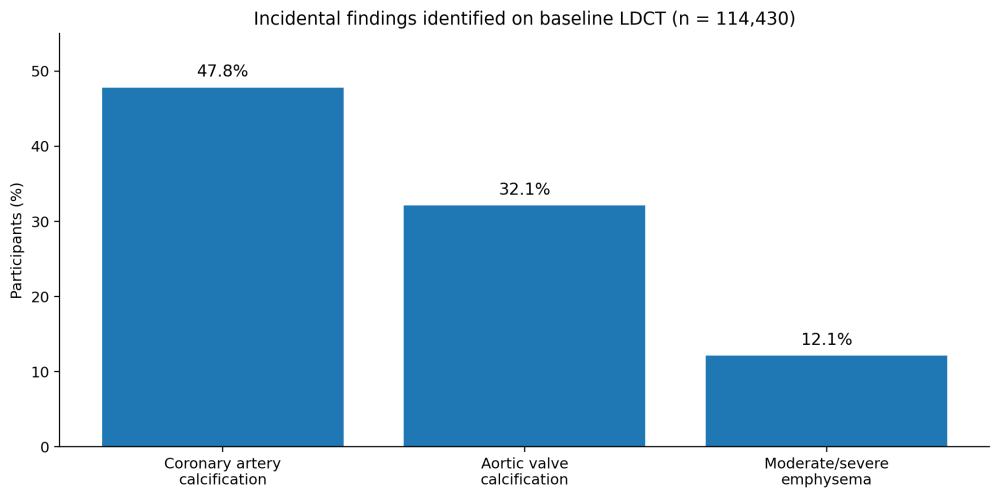
Figure 2. Incidental findings identified on baseline LDCT in the initial-phase cohort (n = 114,430). Data source: Lee RW et al., Nature Medicine (2026), CC BY 4.0.
For imaging leaders, this is the operational warning. Increasing CT throughput without building the downstream pathway risks shifting the bottleneck from radiology into respiratory medicine, cardiology, surgery or oncology.
Access improves only if participation improves
England deliberately began rollout in areas with high lung cancer incidence and mortality, many of which are also highly deprived. That has helped direct screening towards populations with the greatest burden of disease, but participation remains uneven.
Overall uptake of the Lung Health Check offer was 49.0% across the five-year period, though the authors report that the latest uptake figures had risen above 60% as rollout progressed. The study found lower engagement among people living in the most deprived areas and among people from non-white ethnic groups. The programme has therefore demonstrated that geographic access to mobile scanners does not automatically translate into participation. Invitation methods, trust, primary-care data quality and patient communication remain part of the screening infrastructure.
What this means for CT strategy
The UK government previously estimated the annual cost of full rollout at £270 million (approximately €317.5 million). Full national coverage is expected by 2030. For CT services, expansion means sustained demand for low-dose protocols, mobile and fixed scanning capacity, thoracic reporting expertise, nodule software, quality assurance and longitudinal data systems.
The most important lesson is that successful lung screening is not created by buying additional CT capacity in isolation. England’s programme works as a connected pathway: risk selection, community access, standardised imaging, computer-assisted nodule assessment, specialist reporting, multidisciplinary review and downstream treatment capacity.
For health systems moving from trials to national screening, the challenge is whether the entire pathway can absorb the volume without sacrificing quality, access or timely treatment.
Source: Nature
Image Credit: iStock
References:
Lee RW et al. Implementation of the NHS England Lung Cancer Screening Programme over 5 years. Nature Medicine. Published 23 March 2026: https://www.nature.com/articles/s41591-026-04292-y
Department of Health and Social Care. New lung cancer screening roll out to detect cancer sooner. Published 26 June 2023: GOV.UK