


ICU Management & Practice, Volume 25 - Issue 4, 2025
 PRINT OPTIMISED
SCREEN OPTIMISED
This article illustrates two cases of critically ill patients where protracted and burdensome life-saving measures led to discord and moral distress among the ICU team, eventually mitigated by eliciting clear goals and wishes from the patient despite the plan of care and clinical interventions remaining unchanged. The takeaway in these cases is how to understand (and respond to) the multilevel perception of moral distress.
Introduction
Balancing perspectives when it comes to the critical care of patients that require protracted and burdensome therapy in the intensive care unit (ICU) is a fine art that comes with skill and experience (Rice et al. 2008). Challenges with prognostication of critically ill patients is one of the leading causes of miscommunication, conflict and stress in the ICU (Yin et al. 2024). Issues with communication can lead to differing perspectives about the “right” thing to do, or what “good” care looks like for the patient. These diverging opinions can give rise to moral distress when clinicians feel unable to take the action they believe is ethically correct (Mason et al. 2014).
When clinical teams make choices about life-sustaining care, the balance of proportional burden versus benefit of therapeutic decisions is, ideally, based on patient preferences. When such preferences are absent (or unable to be elicited due to the patient lacking decision-making capacity, as is often the case in the ICU), intensive and often burdensome care without an immediately obvious resolution can lead to feelings of despondence and burnout among clinicians (Boitet et al. 2023). In what follows, two cases are presented that highlight how to understand (and respond to) the multilevel perception of moral distress, nuanced as it is, in real time and the mitigating role that clarity around patient preferences can play in alleviating this moral distress, even when the actual plan of care is not altered.
Cases
An 86-year-old patient was admitted to the ICU after a ruptured abdominal aortic aneurysm. After several weeks on the ventilator with worsening organ failure and escalating support, the ICU nurses and physicians started questioning the utility of continuing life-sustaining therapy, expressing concern over the patient’s suffering and the limited likelihood of a full recovery. The patient’s family and loved ones, however, felt that the patient would have wanted to ‘keep trying until there is no stone unturned.’ The surgeons believed that the complications were being managed and were potentially reversible. The intensivist team held several family meetings with social work and palliative care teams present. Due to the uncertainty of her prognosis and the family’s surgeon’s perspectives, life-sustaining measures were continued. The ICU team, including the physicians and nursing staff, experienced moral distress due to their perception of the ‘pain and suffering being caused.’
However, after several more weeks, the patient’s cognitive status improved and the patient was able to awaken enough to interact with the team, despite still requiring dialysis, vasopressors and mechanical ventilation. Once her decision-making capacity was ascertained, her wishes and preferences were elicited in the presence of family. She expressed that this clinical trajectory was aligned with her goals of care and what she wanted, and she was hopeful that she could recover. In the next few weeks, she slowly recovered and was weaned off major life-sustaining intervention.
The ICU team taking care of her felt an immediate relief and “decrease in their moral distress” once they perceived that potentially inappropriate care was not being thrust upon her, and that her wishes and autonomy were being preserved.
Similarly, a 76-year-old, post-liver transplant patient had a months-long, protracted course in the ICU with prolonged mechanical ventilation with a tracheostomy, dialysis, vasopressors, gastrostomy feeding and muscle wasting. He was anxious at baseline and was being managed with anxiolytics as well as antidepressants. He was often awake and interactive, but had repeated bouts of sepsis, and his mental status waxed and waned. The nursing staff began to express extreme moral distress at the invasive care this patient was undergoing without any ostensible improvement. On discussing with the surgeons, who had a long relationship with the patient, they felt that the patient had known the possible complications and had signed up for the long journey. However, despite hearing the surgical team’s perspective, the nursing staff were obviously upset at seemingly providing non-beneficial care to their patient and potentially exacerbating his anxiety, which they felt was due to such care.
Discussion
Providing treatment to a patient when the patient's values and goals are unknown, especially in the ICU and at the end of life, is stressful. Providers and families ask themselves: Is this what the patient wants? Am I respecting the patient's values? Typically, we look to families to answer the questions, but even with the most conscientious surrogate, there can be great uncertainty. Moral distress occurs when clinicians feel unable to follow what they perceive to be the ethically “correct” plan of care, or when they feel complicit in providing care that they assess to be morally wrong (Epstein et al. 2019). Moral distress is one of the driving forces leading to the attrition of critical care nurses and ICU staff (Fumis et al. 2017). The literature demonstrates repeatedly that delivering care for patients in the ICU against their stated wishes or when clinicians perceive it to be non-beneficial are primary sources of moral distress among ICU clinicians, and especially nurses. In both of the aforementioned cases, moral distress was described by clinicians when the burdens of ongoing care were felt to be disproportional to the observable benefit. However, when the patient's preferences were elicited, it became clear that continued aggressive intervention was goal-concordant, even if the chance of recovery was small. In both cases, the patients were able to communicate that they wished to keep trying if the alternative was death. Once the alignment between the current plan of care and the patient’s preferences was evident, the ICU teams in both instances felt relieved, and the morale improved dramatically.
The cases described above illustrate a common yet often insufficiently addressed phenomenon involving palpable tension and deeply emotional response to the perceptions of inappropriate care, resulting in interpersonal and personal strife. This dynamic arises from the complex relationships between ICU physicians, nurses, families and patients when there is uncertainty of prognosis and patient autonomy. The perception of the ‘inappropriateness’ of aggressive ICU care in a critically ill patient when the burden of treatment may outweigh the benefit, can cause a great amount of guilt for team members and family members alike. When coupled with an often-hierarchal system where nurses may feel unempowered to make decisions, trainees may feel unsafe or unsupported speaking up or raising concern, families may feel that they lack enough control or information to make informed decisions, and senior physicians may be faced with the dilemma of offering non-beneficial clinical care without the express consent of the patient, significant burnout and interpersonal strife can occur. When the patient’s own preferences, values, and wishes are not known, or when they are not in alignment with the family's or the ICU clinician’s own preconceived values and opinions in the given context, there can be discord leading to moral distress (Kon et al. 2016). ICU clinicians, and especially nurses, are staunch patient advocates, upholding their autonomy-based obligations to the patient in preserving the patient's respect and dignity (Nsiah et al. 2019). When care decisions are made that make upholding these values challenging, moral distress and general discord can result. As both cases demonstrate, the ICU physicians and nurses believed that the complex, protracted, and burdensome ICU courses of both patients were unlikely to reflect their true preferences, and that a reasonable person would likely choose to pursue limitations of life-sustaining treatment and comfort-focused care (Abbasinia et al. 2020). Clinicians at the point of care are confronted with bed sores, protruding tubes, grimaces with turning and repositioning, recurrent infections and secretions, and invasive artificial nutrition and hydration. In this context, with limited improvement and frequent setbacks, clinicians may assess this to be a burden out of proportion to the benefit of therapy. For them, the slow improvements are not as visible as the daily discomfort they encounter during patient care.
Further, within a close group of caregivers, a groupthink can develop where the tendency is for people to conform to the beliefs of the entire group, often verified by confirmation bias (Saposnik et al. 2016). Previous experiences of moral distress can result in “moral residue” leading clinicians to become quickly distressed again by similar-seeming cases (Epstein and Hamric 2013). If a patient is unable to express their own preferences, the prevailing assessment of the group may be implicitly assumed to represent the goals of the patient, absent evidence to the contrary. Even with robust discussion with surrogate decision-makers, developing a “substituted judgment” of what the patient would choose is challenging, and the values that are used in shared decision-making are quite subjective (Chavira et al. 2022). Very few caregivers, including family, would actually know what the patient would truly want in the given circumstance. Research demonstrates that the accuracy of surrogate decision makers is little better than chance (Shalowitz et al. 2006). Advanced care directives can give broad guidance, but again lack specificity and context. Given the importance of ascertaining patient preferences and the difficulty in uncovering this information in the ICU context, it is no wonder that moral distress is such a commonly occurring experience.
The article explores how people might form judgments or emotional reactions that are not fully grounded in rational or thoughtful reasoning but instead are more instinctual and based in emotion. This could suggest that the responses are more reactive, based on immediate feelings or assumptions, rather than carefully considered viewpoints informed by accurate information. Indeed, moral distress is often mitigated through carefully orchestrated opportunities for communication, where perspective-taking can occur. In most cases, as we highlight here, the clinical care need not change for the experience of moral distress to diminish; this suggests that affective responses to high-stress environments can be tempered with a more complete set of facts and an understanding of the full range of perspectives. Figure 1 describes a possible algorithm for clinicians to consider when such situations arise.
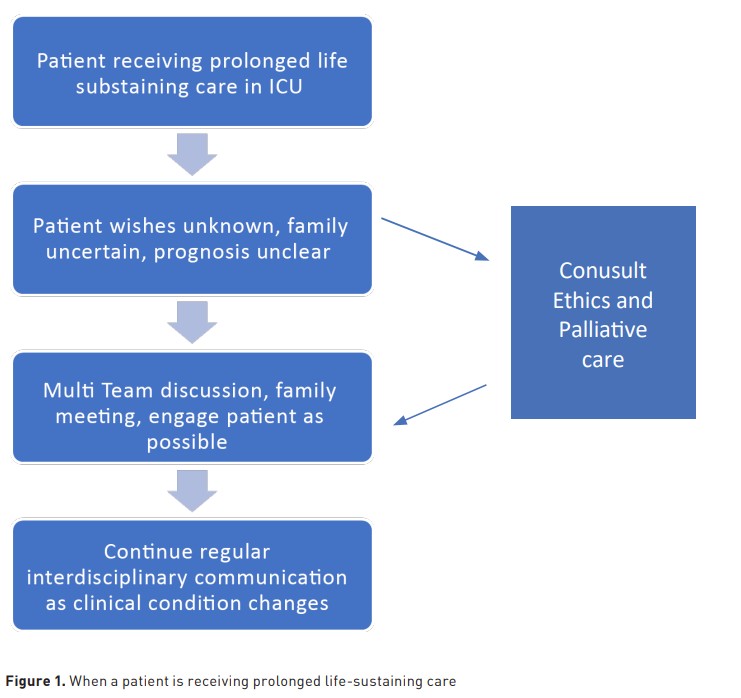
In the cases described above, the moral distress felt by the ICU teams was quickly alleviated when the patients themselves voiced their preferences. In both cases, the care being delivered was assessed to be burdensome, yet still medically indicated by surrogates and clinicians. As such, the values of the patients were vital in deciding whether the proportionality principle favoured continuing life-sustaining care. In both instances, the actual plan of care and related interventions did not change once the patient's preferences were elicited. What changed was the clinical team's perception of these interventions. Addressing morally distressing cases in a timely manner, as well as reflecting on behavioural patterns, either through ethics or palliative care consultation, interdisciplinary debriefing, or ethics rounds, can minimise the escalation of distress and potential groupthink (Cocker and Joss 2016). These cases highlight the way obtaining views from ICU patients, when possible, can have an immense alleviating effect on the morale and quality of care delivered to the patient and mitigate moral distress and burnout (Batson et al. 1987). While it is, of course, not always possible to involve the patient in decision-making in real-time in the ICU, these cases demonstrate that, in the instances when it becomes possible, it is invaluable.
Conclusion
The cases described above illustrate the way the lack of timely communication and uncertainty regarding the patients’ wishes can create moral distress. Leadership and ICU clinicians should strive to improve patient-centred communication, especially in cases where the burdens of life-sustaining intervention are substantial. The first-person perspective of the patient, when obtainable, can mitigate significant distress. In addition, physical and mental rest, and systems that can support these aims, are crucial for people delivering intense and burdensome care in the ICU.
Conflict of Interest
None.
References:
Abbasinia M, Ahmadi F, Kazemnejad A. Patient advocacy in nursing: a concept analysis. Nurs Ethics. 2020 Feb;27(1):141–151.
Batson CD, Fultz J, Schoenrade PA. Distress and empathy: two qualitatively distinct vicarious emotions with different motivational consequences. J Pers. 1987 Mar;55(1):19–39.
Boitet LM, Meese KA, Hays MM, Gorman CA, Sweeney KL, Rogers DA. Burnout, moral distress, and compassion fatigue as correlates of posttraumatic stress symptoms in clinical and nonclinical healthcare workers. J Healthc Manag. 2023 Nov-Dec;68(6):427–451.
Chavira Trujillo G, Gallego Tomás M, López-Pérez B. The link between cognitive and affective empathy and interpersonal emotion regulation direction and strategies. Scand J Psychol. 2022 Dec;63(6):594–600.
Cocker F, Joss N. Compassion fatigue among healthcare, emergency and community service workers: a systematic review. Int J Environ Res Public Health. 2016 Jun 22;13(6):618.
Epstein EG, Hamric AB. Moral distress, moral residue, and the crescendo effect. AJOB Prim Res. 2013;19:1–7.
Epstein EG, Whitehead PB, Prompahakul C, Thacker LR, Hamric AB. Enhancing understanding of moral distress: the measure of moral distress for health care professionals. AJOB Empir Bioeth. 2019 Apr;10(2):113–124.
Fumis RRL, Junqueira Amarante GA, de Fátima Nascimento A, Vieira Junior JM. Moral distress and its contribution to the development of burnout syndrome among critical care providers. Ann Intensive Care. 2017 Dec;7(1):71.
Kon AA, Davidson JE, Morrison W, Danis M, White DB; American College of Critical Care Medicine; American Thoracic Society. Shared decision making in ICUs: an American College of Critical Care Medicine and American Thoracic Society policy statement. Crit Care Med. 2016 Jan;44(1):188–201.
Mason VM, Leslie G, Clark K, Lyons P, Walke E, Butler C, Griffin M. Compassion fatigue, moral distress, and work engagement in surgical intensive care unit trauma nurses: a pilot study. Dimens Crit Care Nurs. 2014 Jul-Aug;33(4):215–225.
Nsiah C, Siakwa M, Ninnoni JPK. Barriers to practicing patient advocacy in healthcare setting. Nurs Open. 2019 Dec 19;7(2):650–659.
Rice EM, Rady MY, Hamrick A, Verheijde JL, Pendergast DK. Determinants of moral distress in medical and surgical nurses at an adult acute tertiary care hospital. J Nurs Manag. 2008;16(3):360–373.
Saposnik G, Redelmeier D, Ruff CC, Tobler PN. Cognitive biases associated with medical decisions: a systematic review. BMC Med Inform Decis Mak. 2016 Nov 3;16(1):138.
Shalowitz DI, Garrett-Mayer E, Wendler D. The accuracy of surrogate decision makers: a systematic review. Arch Intern Med. 2006;166(5):493–497.
Yin J, Zhao L, Zhang N, Xia H. Understanding the interplay of compassion fatigue and moral resilience on moral distress in ICU nurses: a cross-sectional study. Front Public Health. 2024 Oct 28;12:1402532.