


ICU Management & Practice, Volume 26 - Issue 4, 2026
 PRINT OPTIMISED
SCREEN OPTIMISED
Inpatient falls remain a costly, persistent problem despite decades of prevention research, and ambient artificial intelligence offers a promising solution. We discuss its deployment using the Understand phase of the Understand-Transform-Sustain (UTS) framework and identify precision gaps in current eligibility criteria and discuss considerations for future models.
The Individualised Implementation Gap in AI Enabled Care
Inpatient falls are among the most common and costly preventable adverse events in hospital care, affecting an estimated 700,000 to 1,000,000 hospitalised patients annually in the United States (Locklear et al. 2024). Evidence for hospital-based fall prevention interventions remains mixed. A systematic review of 95 trials found limited and inconsistent support for most single-component strategies, including additional physiotherapy and bed or chair alarms, while multifactorial interventions demonstrated greater potential, particularly in subacute care settings (Cameron et al. 2018). More recently, another 2025 systematic review of 104 trials in care facilities reported that multifactorial interventions tailored to individual patient needs and supported by staff engagement were associated with reductions in both fall rates and fall risk, with exercise-based interventions also showing benefit during active implementation (Dyer et al. 2025). Collectively, these findings suggest that personalised, multifactorial approaches may be more effective than single-component interventions, while underscoring the need for further research on their implementation and effectiveness in acute inpatient environments.
Another systematic review and meta-analysis of 43 hospital-based studies similarly found that patient and staff education significantly reduced falls, while bed and chair alarms, wearable sensors and scored risk assessment tools were not associated with significant reductions (Morris et al. 2022). Taken together, these findings indicate that despite incremental improvements in some settings, sustained reduction in fall rates at the system level has proven elusive (Morris et al. 2022; McKercher et al. 2024), and the evidence base supporting many commonly implemented prevention strategies remains limited (LeLaurin and Shorr 2019).
Ambient artificial intelligence offers the potential for a fundamentally different paradigm: continuous observation within the room, behavioural interpretation in real time, and automated intervention (e.g., verbal redirection) for high-risk patients when attempts to exit the bed are detected. Yet the history of healthcare technology implementation is replete with cautionary examples in which promising tools were deployed without adequate understanding of the clinical environment, resulting in alert fatigue, poor adoption, workflow disruption, and limited patient benefit (Stephen et al. 2026). Automated, recorded-voice intervention directed at the patient has independently been validated as feasible and effective for improving orientation and reducing delirium in critically ill patients (Munro et al. 2017, 2021), although, to our knowledge, it has not yet been evaluated as a fall prevention intervention in its own right.
The concept of risk stratified precision intervention, delivering the right strategy to the right patient at the right time based on individual characteristics, is well established in pharmacogenomics and oncology (Rituraj et al. 2025; Tsimberidou et al. 2020; Weinshilboum and Wang 2017). In this context, precision medicine refers to tailoring intervention activation, monitoring intensity and intervention design according to risk profiles specific to each patient, specifically their behavioural patterns and clinical presentation. The application of personalised risk to the implementation of clinically guided technology enabled by AI, however, remains underdeveloped and to our knowledge, few published frameworks explicitly apply precision medicine principles to determine AI eligibility, activation thresholds, and individualised intervention intensity during implementation.
A precision implementation approach asks: Which patients should this AI serve? What data signals define eligibility? How should intervention intensity vary across patient phenotypes? These questions should not be first considered at the Transform (implementation) phase; answering these questions requires systematic understanding. We propose these questions as a future-state, hypothesis-generating model for precision AI implementation rather than as an established evidence-based approach. Prospective evaluation will be needed to determine whether this form of risk stratified orchestration improves implementation outcomes and/or patient benefit.
The UTS Framework as a Precision Implementation Tool
The Understand-Transform-Sustain (UTS) framework was developed to provide a structured, quality improvement approach to AI integration in clinical settings (Gerbaud et al. 2026). The framework posits that trust, from both patients and clinicians, is the central prerequisite for effective AI adoption. Trust is built not through algorithm accuracy alone, but through transparency, workflow alignment, equity, and organisational readiness.
The Understand phase may provide the foundational conditions needed to support more precise AI deployment. It encompasses: (1) clinical problem characterisation, (2) technology identification and evaluation, (3) workflow mapping, (4) data landscape assessment, and (5) building stakeholder trust. In this paper, we argue that each of these steps can support precision care by helping determine whether and how AI interventions should be matched to individual patient needs.
Technology selection itself is a tailored implementation decision. Just as personalised medicine matches therapies to biological phenotypes specific to the patient, precision implementation will require matching AI capabilities to the characteristics of the clinical workflow, patient population, available data, and operational environment in which the technology will be deployed. The relevant question is therefore not simply whether an AI system can perform a given task, but whether its capabilities, detection characteristics, and intervention mechanisms are appropriate for the clinical problem and population in which it will operate.
The Understand Phase: A Precision Medicine Lens
Step 1: Identifying the Right AI Technology
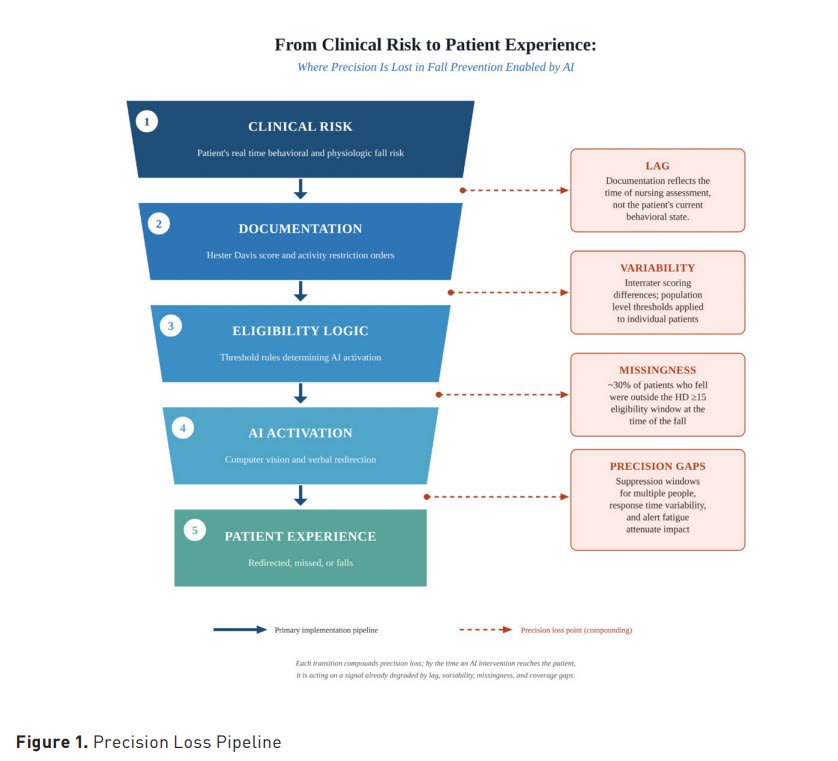
The first decision in precision AI implementation is choosing the right tool for the right clinical problem. This choice has direct implications for patient selection, data architecture, and the feasibility of personalised intervention orchestration. Figure 1 guides the Understand Phase and the discussion throughout this section.
Evaluating Ambient Intelligence for Fall Prevention
At Mayo Clinic Jacksonville, a computer vision ambient AI platform was selected for inpatient fall prevention. This system uses computer vision to continuously monitor consented patient rooms, detects behaviours associated with the risk of bed exit, and delivers automated verbal redirection when a patient attempts to get out of bed unassisted. Unlike conventional bed alarms, which generate alerts based on a reduction of weight experienced as patients exit the bed, ambient computer vision can detect positional cues that precede an attempted bed exit. This creates an opportunity for earlier intervention through verbal redirection prior to the patient getting up unassisted, thereby theoretically offering increased potential to reduce falls assuming the patient responds to an automated verbal request not to exit the bed unassisted.
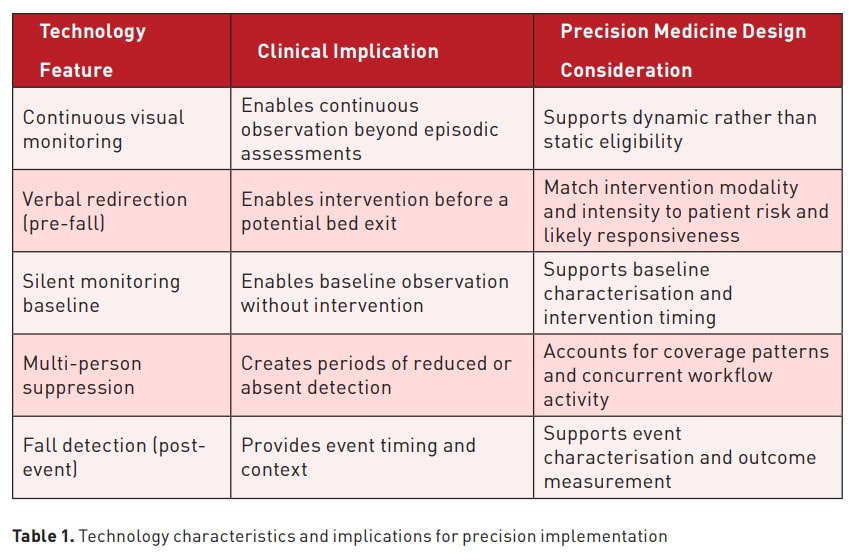
Understanding the system’s detection logic, consent architecture, and suppression rules was a prerequisite for incorporating eligibility criteria specific to the patient into its design. Key platform characteristics identified during the Understand phase include:
- Continuous video monitoring of the room with edge computing
- Automated verbal redirection with configurable scripts
- Silent monitoring mode for baseline measurement without intervention
- Suppression logic that makes it possible to pause monitoring when more than one person is present in the room
- Fall detection capability, distinct from fall prevention alerts
- Capture of monitoring, intervention, and fall-related events to support implementation evaluation and continuous improvement
Some of these characteristics represent general considerations for ambient AI implementation, whereas the rule that can suppress detection when more than one person is in the room was intentionally designed to offer flexibility in how and under what circumstances redirects are delivered (e.g., nursing staff is present).
Consideration of false detections is a key component of the Understand phase as unnecessary alerts and/or redirects can negatively impact staff’s trust in the technology, unintentionally discourage patient ambulation, and potentially negatively impact patients’ experience of care. Table 1 illustrates a broader principle of precision AI implementation: eligibility criteria for intervention models must account not only for what an AI system can detect, but also for the operational conditions under which detection or intervention is unavailable.
Step 2: Understanding the Clinical Workflow
Precision AI implementation requires a granular understanding of the clinical workflows that govern risk identification, documentation, and care delivery. Two constructs drawn from the electronic health record (EHR) were evaluated as potential eligibility signals for fall prevention activation: the Hester Davis (HD) score and activity restrictions ordered by a physician, particularly orders that limit or restrict assisted ambulation.
EHR-Based Risk Documentation: The Hester Davis Scale
The HD Scale is a validated tool, administered by nurses, that quantifies patient fall risk across multiple domains, including recent fall history, mental status, mobility, and medication exposure (Hester and Davis 2013; Kaiser et al. 2021). At our institution, HD scores are documented by trained bedside nursing staff at a minimum every 12 hours. Following a descriptive assessment of 2024-2025 data, comparing HD scores of fallers to non-fallers, a score of ≥15 was used as the initial eligibility threshold for computer vision verbal redirection activation. This cut-off is markedly higher than the threshold of ≥7 for bed alerts but substantially lower than the average risk score (HD mean = 24) across fallers over this two-year period.
The Understand phase identified several precision limitations using this documentation-driven eligibility model:
- Score volatility: HD assessments are completed approximately every 12 hours, and a patient’s score may fluctuate across assessments (e.g., 15, 12, and 16), potentially causing intervention eligibility to switch on and off over short periods.
- Interrater variability: different nurses may assign different scores to the same patient based on interpretation of mobility or cognitive domains.
- Documentation lag: EHR scores reflect the time of nursing assessment and documentation rather than the patient's current behavioural state. A patient may have received a score hours before the next monitored period begins.
- Population-level thresholds:the ≥15 threshold was selected based on population-level assessment and may not account for differences in individual risk phenotype.
A larger retrospective analysis of 708 inpatient falls (4 missing HD scores) across more than 94,000 encounters from July 1, 2021, to June 30, 2026, demonstrated that 69.5% of patients who ultimately fell had a HD ≥15 score at time of event. There is not likely a general population-level criteria definition that will bridge the gap and capture a majority of the remaining ~30% of patients who did not meet clinical criteria for intervention during their fall window. This precision gap reflects not a failure of the HD instrument, but a failure to match the assessment instrument's temporal and phenotypic resolution to the intervention capability in real time. It also highlights an important limitation of fall prediction: the inability to accurately predict all fallers as not every fall is necessarily preceded by sufficiently observable risk signals.
A precision medicine approach to Understand-phase workflow mapping would ask:
- At what point in the HD score trajectory does fall risk become clinically significant for a given patient?
- Are there patient subtypes (e.g., delirium-predominant, medication-induced mobility impairment, post-operative cognitive dysfunction) for whom the standard threshold is systematically too high or too low?
- Can longitudinal HD trajectories, not just snapshot scores, define a more precise eligibility phenotype?
- What would the impact be on the non-faller population if more complex or conservative population-level clinical criteria were utilised (e.g., evaluating total patient monitoring/intervention time by fall status)?
Activity Restriction Orders as a Clinical Signal
Physician-ordered activity restrictions, including bed rest, bed rest with bathroom privileges, and "up with assistance" orders, represent a second, clear EHR-based eligibility signal. These orders encode a clinician's judgment about a patient's safe mobility level and represent a complementary data layer to the HD score.
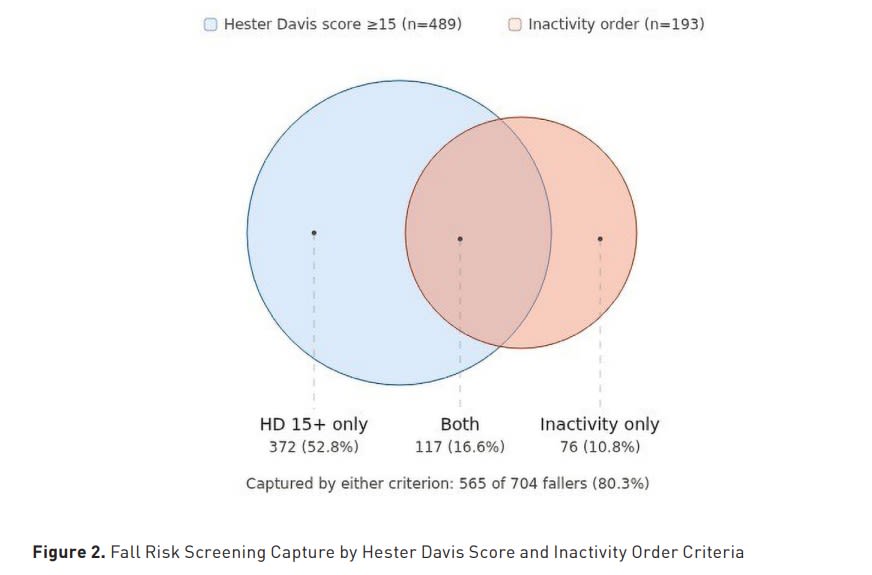
The Understand phase identified several eligibility model variants based on combining HD scores with activity orders. Operationally, this defines four mutually exclusive groups: Hester Davis-only (HD ≥15 without consideration of active activity restriction order), activity-restriction or HD <15 with an active order), dual-positive (both criteria present), and dual-negative (neither criterion present). The “OR” model represents the criteria that is most encompassing of true fallers but also will represent the highest coverage across the population.
The difference between the HD ≥15 model (69.5%) and the OR model (80.3%) implies that activity-restriction-only cases contributed approximately 10.5 percentage points of additional capture. Patients with HD <15 and an active restriction order would severely narrow the qualifying population for fall prevention verbal redirects. Historically for the calendar years 2024-2025, our mean HD faller score was 24 with a median of 23 and 22.5, respectively. Selecting the most appropriate criteria requires a consideration of the qualifying denominator associated with the different eligibility models versus both the likely benefit and burden of the intervention to the patient population. Table 2 shows events that would have been captured utilising five years of retrospective data, July 1, 2021–June 30, 2026, under varied eligibility models.
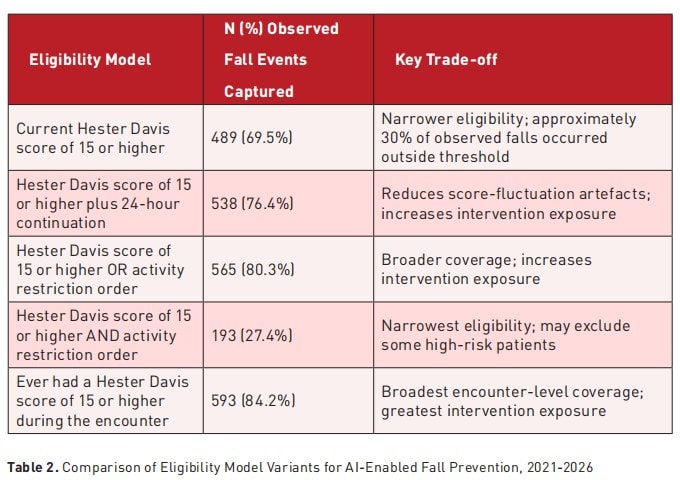
These estimates illustrate a central implementation trade-off: expanding eligibility may increase the proportion of fallers reached by the intervention, while also increasing the duration or frequency of intervention exposure. There are many considerations when examining the possible combinations of available population-level criteria to best capture at-risk patients who would benefit from fall prevention intervention. There must be a careful balance that considers patient understanding (e.g., consistency versus switching back and forth between eligibility) and not expanding criteria to a degree that will discourage safe ambulation among moderate risk patients. The Venn diagram in Figure 2 characterises which fallers are captured uniquely by each signal, and which are captured by both.
The underlying insight is that no single population-level threshold is optimal for all patients. For example, a patient with delirium and high ambulation drive may require a lower activation threshold; a patient with severe motor impairment who is physically incapable of unassisted bed exit may not benefit from verbal redirection at all. Precision AI orchestration requires that eligibility logic be individualised, not uniform.
Limitations of Current EHR-Driven Eligibility
A fundamental limitation of both HD and activity restriction orders as AI eligibility signals is that they are driven by documentation rather than by patients’ current state and behaviour. This creates a temporal mismatch between the continuous observation capability of ambient AI and the episodic rhythm of clinical documentation.
Future data availability that precision AI implementation could address:
- Behavioural signals gathered in real time from the monitoring system itself (e.g., restlessness patterns).
- Integration of Real-Time Location System (RTLS) data to characterise patient mobility patterns
- Continuous bed exit sensor data as a secondary behavioural signal
- Dynamic eligibility re-evaluation triggered by behavioural signals rather than documentation events
Step 3: Precision Data Collection Design
A patient-specific approach to AI implementation does not just describe the existing data landscape; it redesigns data collection to match the resolution, temporality, and phenotypic granularity required for precision intervention. The Understand phase is the appropriate moment to specify these requirements, before technology activation commits teams to a fixed data architecture. Many of these elements would still be classified as future state but we should be consciously focused on realising these possibilities. Based on workflow understanding, we examined precision data collection design principles for ambient AI fall prevention in Table 3.
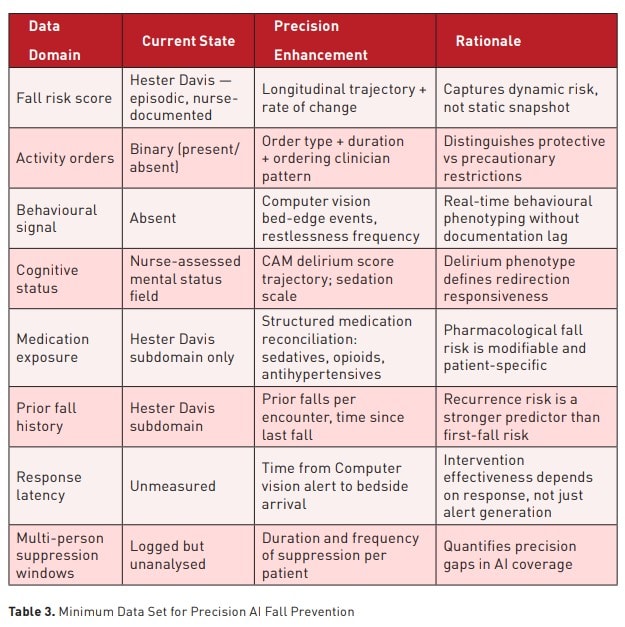
These data elements and enhancement considerations provide a framework that can transform the Understand phase from a passive assessment into a more active precision measurement architecture. The ideal future eligibility state will be one that will enable precise clinical determination, threshold calibration specific to the phenotype and AI orchestration that adapts to the patient's evolving risk profile rather than to population averages. Current eligibility criteria are still utilising population-level clinical documentation-based data, but these analyses are guiding the planning for the Transform phase of implementation.
Step 4: Personalised AI Orchestration: Observed Findings and Proposed Models
Steps 1 through 3 of the Understand phase documented what was directly observed in current practice and can be summarised as HD variability, documentation lag, and suppression windows.
- HD variability: scoring differences between raters and score volatility across nursing assessments produce a population-level threshold that may not reliably track an individual patient's risk in real time. To continue with the delirium example, these patients may behave very differently from cognitively intact patients at equivalent HD scores. Though a patient’s HD score may be altered under the mental status subscale, a single snapshot misses the rising, falling, or volatile trajectory that often carries more signal than the score itself.
- Documentation lag: HD scores and activity restriction orders reflect the time of nursing assessment or order entry, not the patient's current behavioural state. For example, patients beginning a course of sedating medications (i.e., opioids, benzodiazepines, antipsychotics, antihypertensives) will have an increased fall risk that shifts predictably with drug pharmacokinetics, yet the documented score will not reflect that until the next HD entry.
- Suppression windows: the suppression logic that can be used when multiple people are present may leave an unquantified gap in intervention coverage.
The Four Future Models
Proposal 1: Delirium-Phenotype Adaptive Eligibility
Examine lower activation thresholds of risk scores and eligibility criteria for CAM-positive patients; modify verbal redirection script to delirium-specific language; potentially rely on nursing or virtual monitoring rather than using AI redirection. This is because these patients may behave very differently from cognitively intact patients at equivalent HD scores. Though a patient’s HD score may be altered under the mental status sub scale, a single snapshot misses the rising, falling, or volatile trajectory that often carries more signal than the score itself.
Proposal 2: Pharmacological Risk Dynamic Adjustment
A precision implementation would activate heightened AI monitoring during peak drug effect windows (e.g., 2–4 hours post-opioid administration) and allow subsequent threshold relaxation.
Proposal 3: Behavioural Signal–Driven Real-Time Eligibility
Rather than relying solely on HD scores, a precision AI architecture could incorporate computer vision behavioural signals, such as nocturnal restlessness and repeated position changes, to dynamically adjust eligibility in real time. A patient below the documentation threshold who exhibited repeated behaviour patterns could trigger escalated monitoring; a patient who has not repeated specified behaviours in a defined number of hours would have intervention suspended.
Proposal 4: Encounter-Level Risk Trajectory Matching
Machine learning models trained on historical encounter trajectories could inform which patients are most likely to reach the eligibility threshold in the next 12–24 hours, potentially enabling preventive AI activation before the threshold is formally crossed.
Discussion
This paper describes the Understand phase of the UTS framework as a preparatory step necessary in precision medicine. When applied rigorously, the Understand phase yields patient-specific answers to the three foundational questions of precision AI implementation: Who receives the intervention? With what data signals? At what intensity? The experience of implementing fall prevention at our institution illustrates both opportunities and gaps. The current eligibility model relies on HD≥15, which would have captured 69.5% of fallers in the retrospective patient population examined. This leaves substantial room for precision targeting improvement that cannot be closed without continuing to reconceptualise eligibility as dynamic rather than static options become available.
Documentation-driven eligibility remains an important source of potential precision loss in AI-enabled fall prevention. Although EHR-based assessments provide structured and clinically validated measures of fall risk, they are typically performed at predefined intervals and may not fully capture changes in patient status occurring between assessments. This temporal disconnect is particularly relevant because fall risk is dynamic and can fluctuate over the course of a hospital stay. Consequently, there is growing interest in supplementing structured documentation with continuously generated behavioural and contextual signals. Emerging advances in multimodal AI demonstrate the potential to integrate audio, video, and text data collected during routine clinical encounters to support near real-time updating of patient information and risk profiles (Michalowski et al. 2026). In parallel, studies evaluating ambient AI documentation have reported reductions in clinician documentation burden while maintaining or enhancing the completeness of clinical notes, suggesting that richer encounter-level data can be captured without substantially increasing workload (Guo et al. 2026).
Together, these developments support a precision AI framework in which continuously available behavioural signals augment, rather than replace, structured EHR-based assessments, enabling more responsive and precise fall risk identification and prevention strategies.
Although precision implementation may require greater upfront investment in workflow assessment and data architecture, it may improve fall-prevention efficiency by directing interventions toward patients with the greatest individualised risk. Patient-centred models such as Fall TIPS demonstrate that tailoring interventions to patient-specific risk factors can reduce falls and injuries, while AI-enabled systems have shown the feasibility of near-term fall-risk prediction and precision prevention recommendations (Dykes et al. 2020; Blake JM et al. 2024). Calibrating AI activation to patient phenotype reduces unnecessary verbal redirects, decreases alert burden on nursing staff, and concentrates intervention resources where behavioural risk is highest. This is consistent with recent findings that clinical decision support systems based on machine learning, when calibrated to reduce false-positive alerts and target genuinely high-risk cases (e.g., medication errors involving drugs that look alike or sound alike), meaningfully reduce alert fatigue without sacrificing detection of true risk (Chen et al. 2024). Conversely, evidence from clinical automation practice shows that AI systems deployed without calibration that accounts for workflow tend to increase, not decrease, cognitive and documentation burden regardless of their underlying predictive accuracy, reinforcing that precision calibration, not raw model performance, determines whether AI reduces or adds to alert burden (Sathyakrishna et al. 2026).
Explicit precision specifications are ideally understood and determined before technology activation, which will become the implementation contract that governs the Transform phase. Transparency is not a peripheral design feature but a precondition for clinical adoption: a systematic review of AI-based clinical decision support systems identified system transparency as one of the most consistently cited factors shaping whether healthcare workers trust and adopt these tools (Tun et al. 2025), and emerging evaluation frameworks such as TRUST-AI formally position transparency as the first domain clinicians should assess before deployment (Rothwell et al. 2026). Without this transparency, precision medicine intentions at the design stage will be undermined by unknown algorithmic biases at the execution stage.
Equity must be embedded in precision design approaches to optimise for performance, and systematically assess performance equivalency across race, age, sex, language, and cognitive status subgroups. Equity analysis is not optional but a precision requirement. This concern is well documented in the literature; Rajkomar et al. demonstrated that machine learning models trained without explicit attention to subgroup performance can systematically disadvantage already marginalised patients (Rajkomar et al. 2018), and more recent reviews continue to identify data bias, algorithmic bias, and biased clinician–patient interaction patterns as recurring failure modes across clinical AI applications (Fahim et al. 2025; Hanna et al. 2025).
Taken together, these findings suggest that implementation success depends less on AI alone and more on the quality of the understanding that precedes deployment. The Understand phase identifies the conditions necessary to align technology capabilities, clinical workflows, patient risk profiles, and organisational trust, all of which warrant future research, specifically in the era of AI adoption. Prospective studies should validate activation thresholds based on phenotypes against outcomes at the patient level rather than population-level capture rates. Machine learning eligibility models that incorporate behavioural and trajectory signals will require external validation before they can replace or supplement documentation-based thresholds but are likely the future ideal precision state.
Future implementation studies should evaluate AI eligibility as a dynamic, patient-centred process rather than a fixed documentation threshold. Incorporating behavioural signals, temporal changes, and individual risk factors may improve the precision of intervention activation while maintaining safety and usability. Evaluation should also extend beyond predictive performance to include intervention appropriateness, alert burden, workflow integration, patient outcomes, and equity. Ultimately, this approach could enable AI systems to move beyond population-level risk prediction towards adaptive interventions that respond to changes in a patient's clinical and behavioural status.
Limitations
These experiences arise from a single tertiary academic medical centre in the southeastern United States, which may limit generalisability to other centres based on staffing, workflow, patient populations, and resources. However, we feel that our approach remains broadly applicable as it prescribes thoughtful planning prior to implementing AI tools, rather than describing a specific product. Second, we evaluated retrospective data to help guide current implementation and clinic criteria eligibility determination, which can shift over time and has not yet been prospectively examined. Finally, there is limited evidence currently available to support phenotype-specific activation thresholds for fall prevention, which will be important areas for future research.
Conclusion
Ambient AI offers an opportunity to move fall prevention from episodic risk assessment toward continuous, individualised intervention. However, successful implementation depends less on the technology itself than on how well organisations understand the clinical environment into which that technology is introduced. By systematically evaluating technology capabilities, workflow constraints, and available clinical signals, organisations can design interventions enabled by AI that more closely align monitoring intensity and intervention strategies with risk profiles specific to the patient rather than population-level assumptions.
Although illustrated through inpatient fall prevention, the principles described here extend beyond a single use case. As healthcare increasingly adopts ambient intelligence, virtual care platforms, predictive analytics, and autonomous decision support systems, implementation strategies must evolve from uniform deployment models toward individualised approaches that account for patient characteristics, clinical context, and operational realities. Ultimately, we propose that the Understand phase serves as the foundation for precision implementation. Before organisations ask whether an AI system works, they must first determine for whom it should work, under what conditions, with which data, and with what safeguards. The quality of those answers may ultimately determine the success, scalability, and trustworthiness of AI in healthcare.
Acknowledgement
We gratefully acknowledge Richard Littler, GCP and Matt Nold, MHA, RHIT for creating the data pipelines to support the new ambient monitoring system and integrating the patient safety reporting. Their efforts were foundational to the development and execution of the intervention illustrated throughout this manuscript.
Conflict of Interest
None.
References:
Cameron ID, Dyer SM, Panagoda CE, Murray GR, Hill KD, Cumming RG, Kerse N. Interventions for preventing falls in older people in care facilities and hospitals. Cochrane Database Syst Rev. 2018;9(9):CD005465.
Chen C-Y, Chen Y-L, Scholl J, Yang H-C, Li Y-CJ. Ability of machine-learning based clinical decision support system to reduce alert fatigue, wrong-drug errors, and alert users about look alike, sound alike medication. Comput Methods Programs Biomed. 2024;243:107869.
Cochrane Central Editorial Service, Dyer SM, Kwok WS, Suen J, Dawson R, Kneale D, Sutcliffe K, Seppala LJ, Hill KD, Kerse N, Murray GR. Interventions for preventing falls in older people in care facilities. Cochrane Database of Systematic Reviews. 1996 Sep 1;2025(8).
Fahim YA, Hasani IW, Kabba S, Ragab WM. Artificial intelligence in healthcare and medicine: clinical applications, therapeutic advances, and future perspectives. Eur J Med Res. 2025;30(1):848.
Gerbaud AF, Guardia MB de la, Booth SC, Adams L, Cox MD, Hunsinger K, Tan N, Gulden M, Menser T, Reichard R, Dowdy SC, Franco PM. Process improvement before artificial intelligence and automation: building trust with the Understand-Transform-Sustain framework. mcp:iqo. 2026;10(4).
Guirguis-Blake JM, Michael YL, Perdue LA, Coppola EL, Beil TL. Interventions to prevent falls in older adults: updated evidence report and systematic review for the US Preventive Services Task Force. JAMA. 2018;319(16):1705-16.
Guo Y, Wang J, Hu D, Tam S, Gilman C, Chow E, Perret D, Pandita D, Zheng K. Evaluating ambient artificial intelligence documentation: effects on work efficiency, documentation burden, and patient-centered care. J Am Med Inform Assoc. 2026;33(2):273-82.
Hanna MG, Pantanowitz L, Jackson B, Palmer O, Visweswaran S, Pantanowitz J, Deebajah M, Rashidi HH. Ethical and bias considerations in artificial intelligence/machine learning. Mod Pathol. 2025;38(3):100686.
Hester AL, Davis DM. Validation of the Hester Davis Scale for fall risk assessment in a neurosciences population. J Neurosci Nurs. 2013;45(5):298-305.
Kaiser J, Wills N, Reilly T, Pratt J, Tumbleson V, Niemeyer M, Mindling G. A roadmap for practice-based evidence: validation of the Hester Davis Fall Risk Scale. J Nurs Care Qual. 2021;36(3):223-8.
LeLaurin JH, Shorr RI. Preventing falls in hospitalized patients: state of the science. Clin Geriatr Med. 2019;35(2):273-83.
Locklear T, Kontos J, Brock CA, Holland AB, Hemsath R, Deal A, Leonard S, Steinmetz C, Biswas S. Inpatient falls: epidemiology, risk assessment, and prevention measures. A narrative review. HCA Healthc J Med. 5(5):517-25.
McKercher JP, Peiris CL, Hill A-M, Peterson S, Thwaites C, Fowler-Davis S, Morris ME. Hospital falls clinical practice guidelines: a global analysis and systematic review. Age Ageing. 2024;53(7):afae149.
Michalowski M, Topaz M, Peltonen LM. An AI-enabled nursing future with no documentation burden: a vision for a new reality. J Adv Nurs. 2026;82(1):907-12.
Morris ME, Webster K, Jones C, Hill A-M, Haines T, McPhail S, Kiegaldie D, Slade S, Jazayeri D, Heng H, Shorr R, Carey L, Barker A, Cameron I. Interventions to reduce falls in hospitals: a systematic review and meta-analysis. Age Ageing. 2022;51(5):afac077.
Munro CL, Cairns P, Ji M, Calero K, Anderson WM, Liang Z. Delirium prevention in critically ill adults through an automated reorientation intervention - a pilot randomized controlled trial. Heart Lung. 2017;46(4):234-8.
Munro CL, Liang Z, Ji M, Elías MN, Chen X, Calero K, Ely EW. Family automated voice reorientation (FAVoR) intervention for mechanically ventilated patients in the intensive care unit: study protocol for a randomized controlled trial. Contemporary Clinical Trials. 2021;102:106277.
Rajkomar A, Hardt M, Howell MD, Corrado G, Chin MH. Ensuring fairness in machine learning to advance health equity. Ann Intern Med. 2018;169(12):866-72.
Rituraj, Pal RS, Wahlang J, Pal Y, Chaitanya M, Saxena S. Precision oncology: transforming cancer care through personalized medicine. Med Oncol. 2025;42(7):246.
Rothwell R, Julius A, Crichton R. TRUST-AI. J Perioper Pract. 2026;36(1-2):6-11.
Sathyakrishna BR, Lourdunathan A, Nagarajappa P, Vinson Iyapillai I, Subramaniam R. The real ‘catch’ in clinical automation: rethinking artificial intelligence for healthcare workflows. Cureus. 2026;18(6):e111390.
Stephen K, Pu D, Weller-Newton J, Manohar R, Haines TP. Attitudes towards remote monitoring for falls prevention among staff, patients, residents and families in hospital and aged care: scoping review. Journal of Advanced Nursing. n/a(n/a).
Tsimberidou AM, Fountzilas E, Nikanjam M, Kurzrock R. Review of precision cancer medicine: evolution of the treatment paradigm. Cancer Treat Rev. 2020;86:102019.
Tun HM, Rahman HA, Naing L, Malik OA. Trust in artificial intelligence-based clinical decision support systems among health care workers: systematic review. J Med Internet Res. 2025;27:e69678.
Weinshilboum RM, Wang L. Pharmacogenomics: precision medicine and drug response. Mayo Clin Proc. 2017;92(11):1711-22.
Yuan S, Yang Z, Li J, Wu C, Liu S. AI-powered early warning systems for clinical deterioration significantly improve patient outcomes: a meta-analysis. BMC Med Inform Decis Mak. 2025;25(1):203.